Intermission
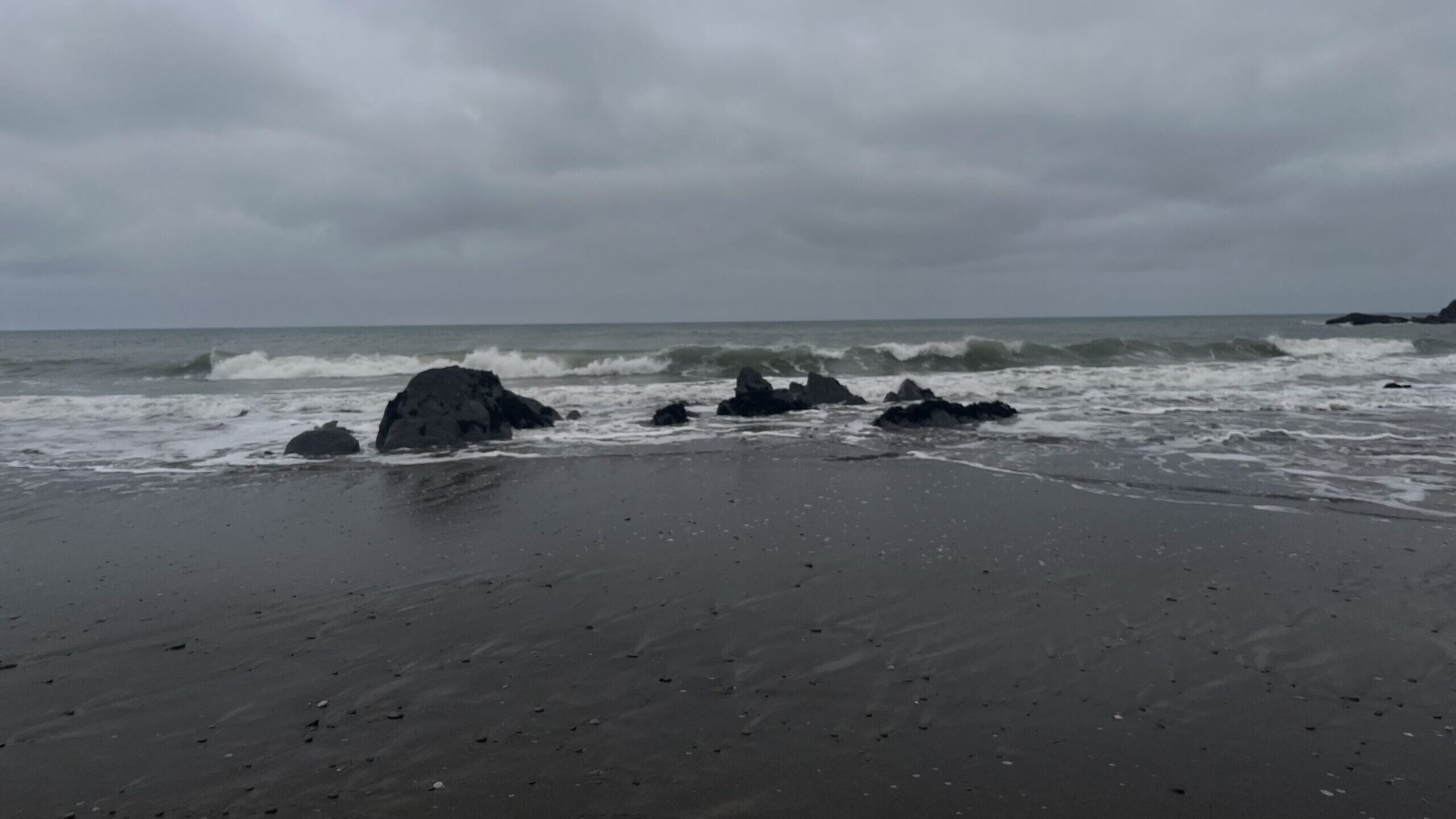
The sky is deep, dark, and violent, hanging low. In the distance, three seagulls sail the wind, twisting their bodies higher, then lower, then higher again. It is monumentally loud – the sound of the sand scattering across the beach, the crashing waves, the February air hitting the rocks to the West. June is in the middle of it all, slow. Head down, scanning the sand for treasures. She’s already gathered three shells and a small stone in her pocket.
She imagines giving one of them to Martha- the grimacing smile she would pull, dutifully accepting another of June’s strange offerings. Oscar would be much more amused- he would know why certain artefacts made their way into June’s pocket. She wonders how Ettie would react to receiving one of these broken shells, and shakes her head, eyes scrunched tight at the thought.
Not now, not here.
Each step is a labour. She dances between the drier sand that doesn’t allow for sturdy footfall, then down, closer to the waves, where her feet sink several inches into the shore. There is so much movement. Her hair wraps tight around her neck, noose-like, and sand uplift gathers at the corners of her mouth like crumbs of toast. The sea is endless. Forwards, and backwards, and forwards, and backwards.
How deep does the sand go? How far would June have to swim before encountering something that saw her prey-like?
There are sandy deposits that take the form of ripples to the left. Closer to the shore, each sliding wave leaves the sand bubbling and popping. Her vision is dotted with driftwood and big stalks of ochre seaweed, limbs splayed like carcasses- victims to the tides and the fury with which they change.
If Mum were here, she’d be calling out to June to step back from the water’s edge. She’s close enough that with each crash, the frothy foam comes to kiss the toes of her boots. June is tempted to step in, shoes and all, just to spite the manners of a woman who isn’t even there. It’s started to rain, little spit collecting between her eyelashes. She grabs into her stomach, where it’s cramping, takes the spite, and tosses it into the sea with a sharp wrist, skim it elsewhere: release it.
Not here, be good.
This moment is entirely removed from everything else: the wolf at the door, the world beyond. The dishes, the drink, the words she hasn’t been able to say and the people she can’t bear to think about. She rubs them out into the sand like a doormat. This is the world beyond. June is nothing on the beach. A body-like shape built tall from buckets filled with sand. She’s a 5-foot-9 castle of little rocks and microscopic creatures held together with damp hands. June falls away, scatters, deposits further down the beach, becomes something again, embroidered with seaglass and iridescent fractures of shells, and grasping hands of seaweed that reach and reach and reach.
Forwards, and forwards, and forwards, and forwards. One day, the houses that dot the cliffs along this stretch of coast will fall into the craggy rocks below. Time will march on, the moon will still rise. The people who inhabit those houses will die or otherwise move away. Perhaps some will try for a while, to wait out the storm, before realising this storm is fuelled by a natural rage that cannot be tempered by the whims of technology or a few extra rocks at the base of the cliff. Perhaps someone will go down with their ship: a loyalist. Maybe they’ll be standing at the window, mug of coffee in hand, when the final defence falls, watching as the sea and sand and earth that they pray to charges straight towards them. Let us hope that the waves will bypass the teeth and swallow them whole.
How does that poem go?
“You might think that the sea is company,
Exploding comfortably down on the cliffs,
But no: when it begins, the flung spray hits
The very windows, spits like a tame cat
Turned Savage”
Though Heaney wrote that back in 1969, June can almost see him at her shoulder with the lid of his pen between his teeth, scribbling about the beaches of Ireland before the wind and the waves consume him and them entirely. Trying to stand in that “huge nothing” that now whips at June’s upper body and shakes at her trouser legs.
It is quite overwhelming to be so confronted by your insignificance. Overwhelming, but here and now, it is everything. To be nothing: to let your body be brutalised up and down the beach by the whims of the strong wind, to end up soaked and shivering, body jittering and lifting, cast about like the birds above, spinning towards the sun.